
Table of Contents
- Why Female Sports Fan Apparel Sizing Matters
- How to Measure for a Women's Jersey
- Women's Sports Jersey Size Guide and Reading Charts
- Women's vs. Men's Jersey Sizing: Key Differences
- Should a Football Jersey Be Oversized or True to Size
- Choosing Between Sizes and Sizing Up
-
Common Sizing Mistakes to Avoid
- Mistake 1: Buying Your Street-Clothes Size Without Checking the Chart
- Mistake 2: Assuming All Women's Sizes Scale Proportionally
- Mistake 3: Overlooking Sleeve Length and Shoulder Seam Placement
- Mistake 4: Confusing "Oversized Fit" in Product Descriptions With Actual Size
- Mistake 5: Not Accounting for Fabric Behavior After Washing
- Frequently Asked Questions
Last Updated: October 10, 2026
Why Female Sports Fan Apparel Sizing Matters
Getting the right size in women's sports apparel affects how confident you feel, whether the jersey lasts, and whether you'll wear it on game day. Most sports apparel is cut for men's bodies, not women's. When sizing doesn't match your measurements, the fit falls flat and logos sit wrong.

Women's bodies have different chest-to-waist ratios, shoulder widths, and sleeve lengths than men's. A unisex jersey marked "large" might fit your chest but swim at the waist. Understanding female sports fan apparel sizing is the foundation for building a wardrobe you'll actually wear.
How to Measure for a Women's Jersey
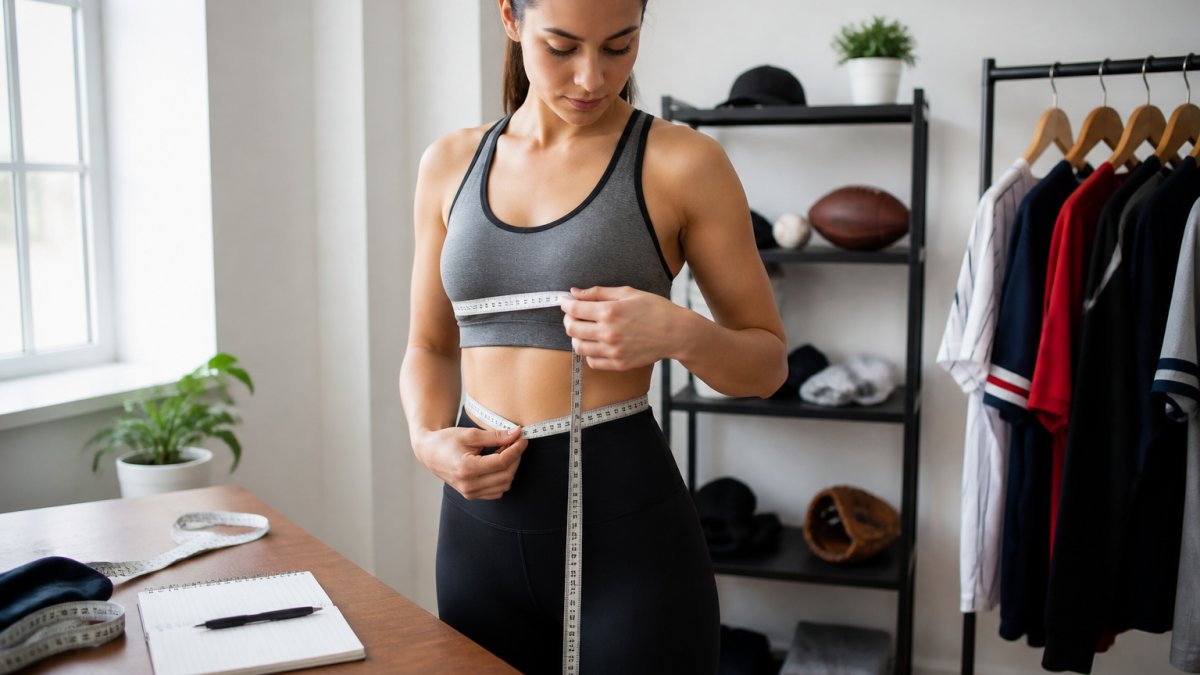
Taking accurate measurements takes five minutes. You'll need a soft measuring tape and clothing that fits close to your body but isn't tight. Measure over a thin shirt or directly on your skin, whatever you plan to wear under the jersey.
Measuring Bust, Waist, and Hip Circumference
Wrap the tape around the fullest part of your chest, keeping it parallel to the ground. The tape should sit snug but allow one finger to slip underneath. This is your baseline for women's sports jersey sizing.
Measure your waist at the narrowest point, typically just above your hip bones. Then measure your hips at the fullest point, usually 7-8 inches below your waist. Record all three numbers.
Recording Shoulder Width and Sleeve Length
Measure from the top of one shoulder bone to the top of the other, straight across the back. This is often overlooked but makes a huge difference in how a jersey drapes.
Measure from the center back of your neck, across your shoulder, down to your wrist with your arm relaxed at your side. Sleeve length varies by brand, so this measurement is essential when comparing size guides.
Women's Sports Jersey Size Guide and Reading Charts
Most size charts follow a standard pattern: XS, S, M, L, XL, and plus sizes. But the actual measurements behind those letters vary wildly between brands. Reading the chart matters more than the size label itself.
Look for the bust, waist, and hip measurements listed for each size. Compare your measurements to those numbers, not to the size you normally wear in street clothes. If your bust is 36 inches, find the size that lists 36 inches.
Check how long the jersey hits, some styles are cropped, others reach mid-hip. This matters for how you'll layer and what you'll pair it with on game day.
Women's vs. Men's Jersey Sizing: Key Differences
Men's and women's jerseys aren't just smaller versions of each other. The cuts are fundamentally different, which is why female sports fan apparel sizing requires its own approach.

Waist Taper and Hip Proportions
Women's jerseys taper at the waist and curve through the hips; men's jerseys hang straight from the shoulders. A men's large might have a 42-inch chest and 40-inch waist. A women's large typically has a 38-inch chest and 32-inch waist.
Sizing down in men's jerseys results in extra fabric at the sides and a boxy silhouette. Women's sports jersey sizing accounts for this shaping from the ground up.
Shoulder Width and Sleeve Geometry
Women's shoulders are typically narrower than men's, and women's sleeves are shorter. A men's medium might have 18-inch shoulders and 32-inch sleeves; a women's medium usually has 16-inch shoulders and 30-inch sleeves. Narrow shoulders mean the armhole sits higher and tighter. Shorter sleeves prevent cuffs bunching at your wrists.
A unisex jersey splits the difference, which means it fits nobody perfectly. Women's jerseys build the geometry around female proportions from the start.
Should a Football Jersey Be Oversized or True to Size
The right fit depends on how you plan to wear the jersey and what activity you're doing. Understanding fit for different contexts eliminates the guesswork.
Fit for Game Day and Stadium Wear
For game day, true-to-size or one size up is standard. A true-to-size fit keeps the jersey proportional and prevents logos from stretching awkwardly when you move. One size up works if you prefer more room and plan to wear a heavier outer layer, but two sizes up will make proportions look off and the hem will drop too far past your hips.
Nike Oakland Raiders Tailgate Long-Sleeve T-Shirt Loose Fit Gray Womens Size S →
Fit for Layering and Cold Weather
If layering under the jersey, measure how much extra room those layers add. A sports bra with padding can add 1-2 inches to your bust; a thermal base layer adds another half-inch to an inch. If your bust is 36 inches and you're adding 2 inches of layering, size up. This is especially important in colder months.

Fit for Casual and Everyday Wear
For casual wear, one size up creates a relaxed silhouette that balances fitted leggings or jeans. The sleeve will hit closer to your elbow and the hem will drop lower on your thigh. Sizing up two sizes breaks down proportions, the shoulder seam sits too far out and the waist taper disappears.
Fit for Movement and Exercise
For exercise or activities requiring full range of motion, true-to-size is usually better. A fitted jersey won't ride up or restrict your shoulders. Check the fabric content: stretch blends move with you; 100% cotton requires true-to-size fit since the fabric won't give as much.
Choosing Between Sizes and Sizing Up
When your measurements fall between two sizes, the decision depends on your fit preference and how you plan to wear the jersey.
If your bust is 36 inches and a medium lists 36 inches while a large lists 38 inches, go with the medium. If your bust is 37 inches, choose medium for a close fit or large for more room.
Most women choose the size that fits their waist, since you can layer or adjust fit at the chest more easily than you can add room at the waist.
Common Sizing Mistakes to Avoid
Most sizing errors stem from ignoring the size chart, conflating different types of fit information, or not accounting for how fabric and construction affect fit.
Mistake 1: Buying Your Street-Clothes Size Without Checking the Chart
You wear a medium in jeans, so you assume you wear a medium in a women's sports jersey. This is the most common mistake, and it fails because jeans and jerseys are cut completely differently. Denim is woven, structured, and doesn't stretch much. Jersey fabrics are often knit blends with 5-10% elastane, which means they move and conform to your body. A medium in rigid denim might translate to a small or medium in a stretchy jersey knit. Additionally, jeans are fitted through the hip and thigh, while jerseys are fitted through the bust and waist. The size that works for one garment type won't work for another.
Mistake 2: Assuming All Women's Sizes Scale Proportionally
A women's XS, S, M, L, and XL are not all cut the same way. The waist taper, the difference between bust and waist measurements, often decreases as sizes get larger. A women's XS might have a 6-inch difference between bust and waist (say, 32 inches bust, 26 inches waist), while a women's XL might have only a 4-inch difference (say, 44 inches bust, 40 inches waist). This means the larger sizes are cut straighter through the torso, not just bigger all around. If you're a larger size and you're used to a dramatic waist definition in smaller sizes, you might find that larger women's jerseys don't taper as much.
Mistake 3: Overlooking Sleeve Length and Shoulder Seam Placement
Sleeve length is easy to ignore because it's not as obvious as bust or waist. But sleeves that hit mid-forearm instead of your wrist, or a shoulder seam that sits an inch too far out on your arm, will make you want to return the jersey. Measure your sleeve length once (from the center back of your neck, across your shoulder, down to your wrist with your arm relaxed), write it down, and check it against the size chart before you buy. Different brands and product lines vary on sleeve length. A women's medium from one brand might have 30-inch sleeves while another brand's medium has 31 inches. That one-inch difference matters.
Mistake 4: Confusing "Oversized Fit" in Product Descriptions With Actual Size
When a product description says "oversized fit," it doesn't always mean the jersey runs large. Sometimes it means the jersey is cut with a loose, relaxed silhouette through the body, but the size label is still accurate to the measurements. Other times it means the jersey is intentionally cut larger than standard. The only way to know is to read the actual measurements in the size chart. If a medium lists a 40-inch bust and the description says "oversized fit," that's a loose cut, not a large size. If you normally wear a 36-inch bust, that 40-inch medium will be 4 inches too big. Conversely, if the description says "true to size" and the measurements match your body, buy that size.
Mistake 5: Not Accounting for Fabric Behavior After Washing
How a jersey fits fresh out of the package is not how it will fit after you wash it. Cotton-dominant blends can shrink 2-5% in the wash, especially if you use hot water or a dryer. A jersey that fits perfectly when new might be snug after a few washes. Polyester-dominant blends shrink less, but they can relax and stretch out with wear. If you're buying a jersey that's mostly cotton, consider sizing up a half-size or choosing a blend with more polyester if you want the fit to remain stable. Check the care label and fabric content before you buy.
Frequently Asked Questions
Should a football jersey be oversized or true to size?
This depends on your fit preference and how you plan to wear it. A true-to-size jersey follows your natural body measurements for a clean, fitted look. An oversized jersey (sizing up one size) provides extra room for layering under cold-weather gear or offers a relaxed, casual silhouette. Measure your bust, waist, and hips first, then decide based on whether you want mobility and layering space or a more tailored appearance.
How do you measure yourself for a sports jersey?
Use a soft measuring tape and wear fitted clothing. Measure your bust at the fullest point under your arms, your waist at its narrowest point, and your hips at the widest point. Keep the tape snug but not tight. Record shoulder width from shoulder bone to shoulder bone, and sleeve length from the center back neck down your arm to your wrist. Compare these measurements to the size chart provided by the brand before ordering.
What is the difference between women's and men's jersey sizing?
Women's jerseys have a tapered waist, narrower shoulders, and shorter sleeves relative to torso length. Men's jerseys have a straighter cut through the torso with broader shoulders and longer sleeves. Women's jerseys are designed around different body proportions, not just scaled-down versions of men's sizes. Wearing a men's jersey often results in excess fabric at the waist and overly long sleeves, which is why accurate women's sizing matters for comfort and appearance.
Why does accurate female sports fan apparel sizing matter?
Correct sizing ensures comfort, confidence, and longevity of your gear. Ill-fitting jerseys bunch, gap at seams, or restrict movement, especially during active wear or layering. Accurate sizing also reduces returns and exchanges, saving time and shipping costs. When your apparel fits well, you feel better wearing it to games and events, and the garment lasts longer without stress on seams from poor fit.