
Table of Contents
- Why Accurate Hat Measurement Matters
- Tools You'll Need to Measure Hat Size
- Step-by-Step: How to Measure Your Head for Hat Size
- Understanding Head Circumference and Sizing
- Fitted Cap Size Chart and Conversion Guide
- How Should a Baseball Cap Fit on Your Head
- Average Hat Size for Men and Women
- Accounting for Hair Volume and Head Shape
Last Updated: August 27, 2026
Why Accurate Hat Measurement Matters
A poorly fitting cap is uncomfortable, shifts during activity, and defeats the purpose of owning quality headwear. When you measure hat size correctly, you eliminate guesswork and ensure your sports cap arrives ready to wear. Online shopping makes this essential, you can't try on a cap before it arrives. Whether you're buying a fitted New Era 59FIFTY or an adjustable snapback, accurate measurement is the foundation for a perfect fit.

Many people guess their size based on past purchases, but this fails because head shapes vary, hair volume changes seasonally, and different cap styles fit differently. Taking five minutes to measure properly saves you from ordering the wrong size and dealing with returns.
Tools You'll Need to Measure Hat Size
A flexible measuring tape is your primary tool, something that bends and conforms to your head without distorting the measurement. A cloth or soft plastic tape measure works perfectly. If you don't have one, use a piece of string and measure it against a ruler.
Paper and a pen matter more than people think. Write down your measurement immediately while the tape is still in position, in both inches and centimeters. A mirror is helpful but optional, it lets you verify the tape is positioned correctly.
Step-by-Step: How to Measure Your Head for Hat Size
Position the Measuring Tape Correctly
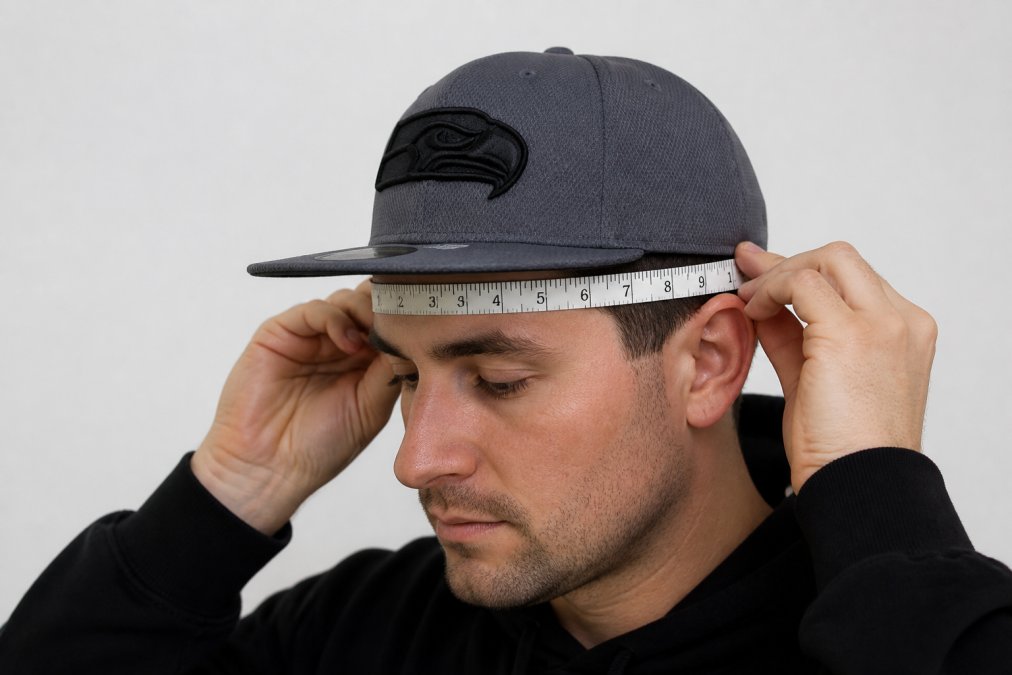
Place the measuring tape just above your eyebrows, mid-forehead. The tape should sit comfortably against your skin without pressing hard or hanging loose. Guide the tape around the back of your head, passing above your ears, not through them. This is critical; running the tape through the ear canal inflates the measurement and leads to oversized caps.
Continue the tape around to the back of your skull, following the widest part of your head. Keep the tape level as it wraps around. Bring the tape back to the starting point at your mid-forehead, overlapping slightly by about half an inch to an inch.
Record Your Measurement
Read the measurement at the point where the tape overlaps itself. If the tape overlaps from the 22-inch mark to the 23-inch mark, your head circumference is approximately 22.5 inches. Write this number down immediately.
Convert to centimeters if needed by multiplying your inch measurement by 2.54. A 22.5-inch head circumference equals approximately 57 centimeters. Many sizing charts use centimeters, especially for international brands.
Measure again to confirm. Your second measurement should be within a quarter-inch of the first. If there's a significant difference, check your tape positioning, the most common error is running the tape too low at the back of the head or positioning it through the ears instead of above them.
Understanding Head Circumference and Sizing
Head circumference is the distance around your head measured at its widest point. This single number determines your fitted cap size. Each half-inch increase in head circumference corresponds to one full hat size. A 22-inch head circumference equals a size 7, while a 22.5-inch circumference equals a size 7 1/8.

Head shape affects how a cap fits beyond just circumference. Some people have oval-shaped heads, others have rounder heads. An oval head might need a slightly tighter fit than a round head of the same circumference. This is why a size 7 from one brand sometimes fits differently than a size 7 from another brand.
Hair volume adds complexity. A person with thick, curly hair might need a slightly larger size than their base head circumference suggests. The hair compresses somewhat under a cap but not completely. Seasonal changes in hair length or styling can shift your ideal cap size by a quarter-size.
Fitted Cap Size Chart and Conversion Guide
| Head Circumference (Inches) | Head Circumference (Centimeters) | Hat Size |
|---|---|---|
| 20.5 | 52 | 6 1/2 |
| 21 | 53 | 6 5/8 |
| 21.5 | 54.5 | 6 3/4 |
| 22 | 56 | 7 |
| 22.5 | 57 | 7 1/8 |
| 23 | 58.5 | 7 1/4 |
| 23.5 | 60 | 7 3/8 |
| 24 | 61 | 7 1/2 |
| 24.5 | 62 | 7 5/8 |
| 25 | 63.5 | 7 3/4 |
This chart applies primarily to fitted caps with structured crowns. The New Era 59FIFTY uses this exact sizing system. Snapback caps with adjustable closures don't use this numbered system because they're designed to fit a wider range of head sizes. Structured adjustable caps fall somewhere in between.
If your measurement falls between sizes, round up. A 22.3-inch head circumference is closer to a size 7 1/8 than a size 7. Caps are slightly forgiving; a size up is better than a size down.
How Should a Baseball Cap Fit on Your Head
A properly fitted baseball cap should feel snug without being tight. You should be able to fit one finger between the cap and your head when you press gently. The structured crown should sit comfortably on top of your head without tilting forward or backward. When you look in a mirror, the cap should appear centered and level, with the brim parallel to the ground.
At the back of your head, the cap should close snugly around the base of your skull. If there's a gap between the back of the cap and your head, the size is too large. Wear the cap for a few minutes to assess comfort during extended wear. A proper fit means the cap doesn't shift when you move or tilt your head.
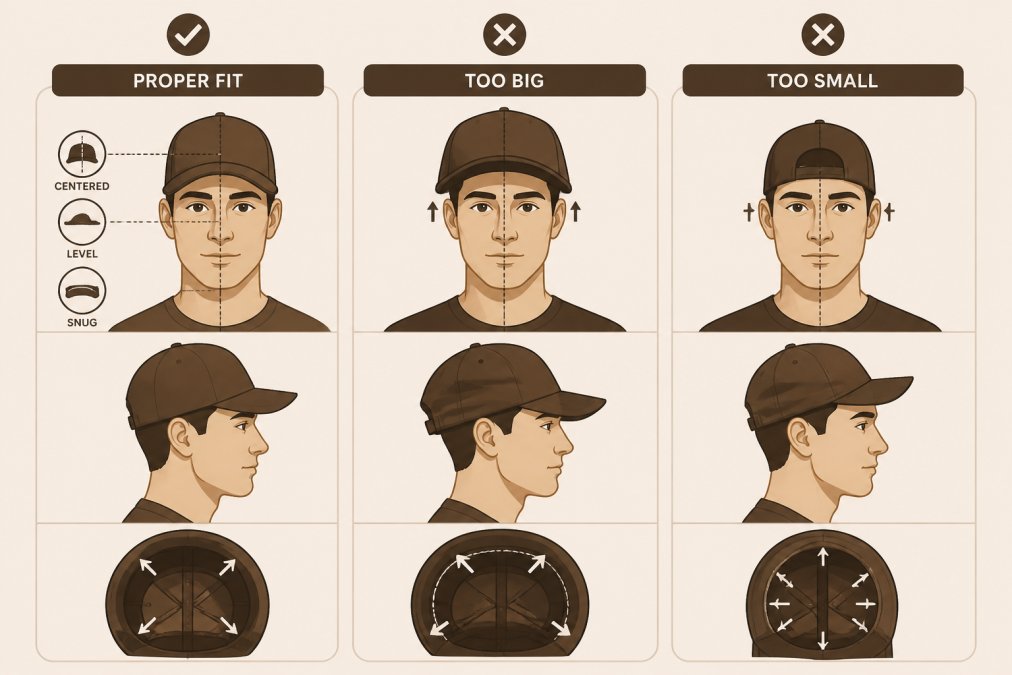
Different cap styles have slightly different fit characteristics. A snapback with an adjustable closure can accommodate more variation. A fitted cap relies entirely on the sweatband and structured crown. The performance fabric matters too, breathable, moisture-wicking materials feel different than heavy canvas caps.
Average Hat Size for Men and Women
Most men's head circumferences fall between 22 and 23.5 inches, corresponding to hat sizes 7 through 7 3/8 (peer-reviewed research). The average men's hat size is approximately 7 1/8, representing a 22.5-inch head circumference.
Women's head circumferences tend to be slightly smaller, averaging between 21.5 and 22.5 inches, corresponding to sizes 6 3/4 through 7 1/8 (peer-reviewed research). However, many women have head circumferences in the 22-23 inch range, overlapping with men's sizing. The distinction between "men's" and "women's" caps is more about cut and styling than size numbers.
Younger people have smaller head circumferences requiring smaller cap sizes. Head circumference typically stabilizes by the early 20s and remains relatively constant throughout life (peer-reviewed research). Head circumference varies significantly by genetics, which is why sizing charts that assume a single "average" can be misleading. Your actual measurement is far more reliable.
Accounting for Hair Volume and Head Shape
Hair volume is one of the most underestimated factors in cap sizing. A person with thick, curly hair might need a size larger than their measured head circumference suggests. The hair doesn't compress completely under a cap and maintains some volume even when pressed down.
Seasonal hair changes affect sizing too. Someone who cuts their hair short in summer and grows it longer in winter might find their ideal cap size shifts. Measure your head circumference during the season when you'll wear the cap most frequently.
Curly hair creates more volume than straight hair of the same length. If your measurement is 22.5 inches and you have thick, curly hair, you might be more comfortable in a size 7 1/4 rather than a size 7 1/8.
Head shape variation is significant. Some people have elongated oval heads; others have rounder heads. An oval head might feel different in a cap than a round head of the same circumference because the cap's structure is designed around a standardized head shape. Try caps in person when possible, especially if you have an unusual head shape or significant hair volume.
Featured Sports Cap Styles and Their Sizing Considerations
Fitted caps with structured crowns, like the New Era 59FIFTY, use the numbered sizing system described in this guide. These caps have a fixed size with no adjustment mechanism. When you order a fitted cap, your measurement directly determines your size.

Snapback caps have an adjustable closure at the back, typically using plastic snaps or velcro. This adjustment mechanism allows a single size to fit a range of head circumferences, usually 3-4 inches of variation. This flexibility makes snapbacks easier to order online because sizing is less critical.
Structured adjustable caps combine elements of both. They have a curved bill and structured crown like a fitted cap but include an adjustable closure system at the back. This provides more precision than a snapback while offering more flexibility than a fitted cap.
Low-profile caps have a lower crown height than traditional baseball caps and might feel different than a standard-profile cap of the same size. Performance caps designed for active sports use moisture-wicking materials and often have ventilation features. These caps sometimes fit slightly differently than traditional canvas caps because of the material properties.
The Vault's collection includes all these styles across multiple sports teams and leagues. Premium New Era 59FIFTY caps use the standard sizing system, so your measurement translates directly to the size you need. For example, consider the New Era 59FIFTY Seattle Seahawks Fitted Cap NFL Hat Gray Mens Size 7 3/8 ($40.00), the New Era 59FIFTY New York Yankees Fitted MLB Logo Black Unisex Size 7 ($24.99), or the New Era 59FIFTY Atlanta Braves MLB Fitted Hat On-Field Baseball Cap Black Size 7 ($28.99).
Accurate measurement takes five minutes and eliminates sizing uncertainty. You've now learned exactly how to measure your head circumference, understand what that measurement means, and choose the right cap size based on your specific head shape and hair volume. Take your measurement, consult the sizing chart, and order your cap with confidence. At The Vault, we stock premium sports caps in the full range of sizes, with fast shipping to get your team gear ready for game day.
Frequently Asked Questions
How do I measure my head for a fitted cap?
Use a flexible measuring tape to measure your head circumference at the widest point: mid-forehead, above your eyebrows, and above your ears. Keep the tape snug but not tight, and record the measurement in inches. This head circumference converts directly to your fitted cap size. For example, a 22.5-inch head circumference equals a size 7 fitted cap. Measure twice to confirm accuracy before ordering.
What is the average hat size for men and women?
The average hat size for adult men is between 7 and 7 3/8, while women typically wear sizes 6 1/2 to 7. However, head sizes vary widely based on individual head shape and size. Rather than relying on averages, measure your own head circumference for the most accurate fit. This ensures your sports cap sits properly without shifting or feeling uncomfortable during wear.
How should a baseball cap fit on my head?
A properly fitted baseball cap should sit snugly on your head without causing discomfort or leaving marks. The sweatband should rest just above your eyebrows and ears, and the structured crown should feel secure but allow room for slight movement. There should be minimal gap between the cap and your head, and the brim should sit level. If you can easily rotate the cap or it shifts during activity, it's too loose. If it causes headaches or leaves red marks, it's too tight.
What if my head measurement falls between two hat sizes?
If your measurement falls between sizes (for example, 22.75 inches), round up to the next size. A slightly larger cap is more comfortable than one that's too tight, especially if you plan to wear it for extended periods or over thick hair. Many fitted caps from brands like New Era, such as the New Era 59FIFTY Seattle Seahawks Fitted Cap, come in half-size increments to accommodate this common measurement scenario.
This article was written using GrandRanker